I’ve been on holiday for almost two weeks now and am on serious down-time. I have avoided all online activities, and especially anything to do with work, and have been enjoying spectacular weather and scenery in Vancouver and surrounds. I still have a few more days to chill out, but thought I’d put up a short post to say hello, and “I’m still here”.
I have, of course, managed to bring my knitting along. I am working on a beautiful shawl in laceweight cashmere yarn; it’s perfect travel knitting – compact, lightweight, and easy. The yarn, Karei by Ito, is gorgeous:
The finished shawl will weigh only 125 grams, and it is almost translucent when knitted up:
I have managed to knit in some absolutely gorgeous spots. Here I am knitting on the porch of Jill’s house on Lilloet Lake. (Jill is the friend who made the teddy bear featured in this post.)
Why am I looking away from that spectacular view? Because the views the other way are just as good!
And here I am knitting on Gibson’s Beach, halfway between Powell River and Lund on the Sunshine Coast:
One last photo before I take back up the holiday mantle. Here are the four of us, at the lake, each wearing a stranded hat:
That’s me in Peerie Flooers, Leah in Bousta Beanie, Doug in Cascade, and Emma in Raven.
I tried my hand at another fairisle hat a few weeks ago, but didn’t get photos until this weekend.
This is the Janine Bajus Raven Hat, and like my previous Cascade Hat (blogged here), is designed by Janine Bajus. She apparently used this design as a teaching tool in her workshops in fairisle knitting and it is easy to see why. It is a very simple pattern to work and to memorise. It was easier to make than the Cascade Hat, and I think only part of that is due to my increasing ease with this technique.
I knitted it in the colours suggested on the pattern page, using Jamieson’s of Shetland Spindrift, which is a really lovely yarn for working fairisle. I thought that the hat would be too long as written and wanted to shorten it; I did this by leaving off the first 6 rows of the pattern (starting the fairisle section at Row 7) instead of trying to re-calculate the decreases on the crown. I think this worked out well and it keeps the crown pattern intact:
I do feel as if the top of the hat is a little bit pointy. Blocking certainly helped flatten out the crown, but I think that perhaps I didn’t do the best blocking job. I may try to block it again.
This hat has very nice colourwork. I especially like the way the teal and the tiny bit of copper livens up the purples. I am happy with how it turned out. This guy, however, seems to think otherwise:
I have nothing to knit. This makes me very grumpy. How, you might ask, could I find myself with nothing to knit? (Doug would certainly ask this if he were at home.) Do I not have piles of stash yarn, bags and boxes of haberdashery and knitting paraphernalia, bookcases full of knitting pattern books and magazines (not to mention, dare I say it, the internet, which is teeming with patterns)?
The sad truth is that, surrounded as I am by the detritus of knitting, I can find nothing to knit. I remind myself of a teen-ager who whines “there’s nothing to do”! Surely, one thinks, they can pick up a book or go for a walk instead of whining? But here I sit, annoyed and grumpy that I have nothing to knit.
I have, of course, looked at patterns. I have looked at patterns until my head nearly explodes, but none is saying “Knit me! Knit ME!”. I have also sorted through my stash to look for creative inspiration. I have even knitted swatches – 7 of them this week – trying to figure out how to best utilise some old skeins of yarn that turned up in the bottom of a box. To no avail.
Since I am feeling grumpy (have you noticed?), I have decided to roll with it and publish a grumbly post regarding a pet peeve. To get to the pet peeve, however, you must first wade through the following tale. One of the things that I found in my stash is five skeins of lovely, hand-dyed sportweight yarn from Skein Queen – a wool and silk mix. I have three skeins of the grey and two of the mix (which is called Fig). Here is a photo:
Unfortunately, I bought these many years ago before I realised how much I disliked variegated yarns. (Truth: I adore variegated yarns in the skein, just not in the knitted product. I am not into speckles, or fades, and I hate pooling.) Regardless, I decided that these skeins might become my next project and so I sought a pattern to use them with. Only a knitter would believe me when I mention how much time I spent searching. It is rather embarrassing.
It is by Lisa Richardson and is called Hip. I kind of like it. However, it is knitted in three different textures of yarn, in many colours, and weaving in all of those ends would be a nightmare. What if, I speculated, I knitted it with just two colours, alternating stripes, but in which one of the colours would alternate between cream, brilliant purple, pink, yellow, and taupe, and the other would be grey? That way, the yarn can be carried up the side of the piece and there would be virtually no ends to weave in. Sounds good, yes?
I should mention at this point that the pattern is in Rowan 53 from 2013. I looked at my stack of Rowan magazines and found that I had ….50, 51, 52, 54, 55…. but no 53! I should have called it a day and kept looking for alternate patterns but instead I searched the internet for someone who was selling Rowan 53, and purchased it. I then had to wait for it to arrive. I should have guessed then that the knitting gods were against this whole enterprise.
When the book arrived, I promptly knitted up a swatch, alternating my two shades:
And guess what? I don’t like it! Not at all! It doesn’t look anything like the pattern in the photo (probably due to the lack of mohair and crunchy textures in my yarn selection, as well as the lack of bright colours). And, it demonstrates why I don’t like variegated yarns. I was expecting a row of purple, and a row of pink, etc. Instead, I got speckles. UGH! Not only that, but the grey and the taupe don’t spark together at all.
At this point, I got a new idea: I would knit something using only the grey. I started by knitting up two swatches in stockinette – one with a US4/3.5mm and one with a US5/3.75mm. These are lovely, with the larger one being perfect, and giving me a gauge of 24×36. However, three skeins is sort of a dead zone – too much to waste it on a pair of mitts or a hat, but too little for most garments. The skein is 363yards/332 metres, for a total of 1089yards/996 metres. (Not counting all of the yards I used up in making multiple swatches.)
My next job was to search everywhere for garments that could be made (in my size!) using only 1000 metres of sportweight yarn. This, as you may have guessed is not easy. I have run so many pattern searches on Ravelry that I could have knitted up a cute tank in the meantime. And here is where my pet peeve comes into play! (Remember the pet peeve, which started this tale?) Why do so many designers not list the yardage needed per size, but instead tell you how many skeins of their preferred yarn you will need? (Most patterns will do both, but I have noticed a trend towards the latter.)
For example, one design states that you will need: “2 skeins for sizes XS and S, 3 skeins for size M, 5 skeins for sizes L and XL”. If I want to substitute yarns, I need to pull out my calculator and start doing some math. However, that still won’t tell me how many yards I will need to make the size L, only how many yards I would need to knit the size XL. This gets more egregious the more yards there are on the skein. If the yarn called for in the pattern has 400 metres on it, and a size L needs 3 skeins and a size XL needs 4 skeins, how much yarn do I really need to knit the L? It could be anywhere between 800-1200 metres! That can make a big difference when I have x-much yarn and I want to know if I can knit said garment with it.
I understand that many patterns are designed for particular yarn companies in order to showcase their yarns; regardless this practice makes me want to tear me hair out!
Okay. I feel calmer now. Rant over. I did just today find a pattern which I think I could knit up with the grey yarn. It is the #09 Eyelet Top, by Rosemary Drysdale from Vogue Knitting, Spring Summer 2019:
Unfortunately, the pattern page on Ravelry states only that it needs 735 – 1176 yards (672-1075 metres) and that it comes in sizes S, M, L, XL, and 2X. This means that I would probably have enough yarn to knit my size. However, I have to buy the magazine first to know for sure. I don’t even know if it’s available yet in the UK. In any case, I can’t cast on now.
Knitting gods: I have listened to you and am about to read a book. Maybe I’ll go for a walk as well.
In England we have four seasons; sometimes all in the same day. Today we have had a bit of everything – sun, clouds, wind, rain, even hail. It was a perfect day to nestle into the cozy warmth of my new cowl.
This is the Highland Rogue cowl, designed by Kate Davies, and knitted with Kate’s 100% wool sportweight yarn, Buachaille. I love this yarn (I used it to knit three pairs of mitts, which you can see here, here, and here). It is a lovely, plump yarn that takes beautifully to both colourwork and texture, and it feels great on the hand.
I have written a few posts about this cowl; it has been on my needles since September. The pattern is not an easy one to “read” on the needles; I had to pay attention to the pattern on every row. This is odd given that it is only a 6-row repeat. Nonetheless, I repeated the pattern in my head over and over again while knitting this. (Perhaps this has more to say about my attention span than the pattern?) While this meant it was not mindless knitting, you can see that the resulting texture is simply gorgeous:
I have used this lovely orange shade called Highland Coo. It is a cool orange, with no yellow tones, and a strong, rich hue that looks good in sun and shade.
I especially like the way it looks against the blues and bold patterns of my Sofi cardigan (which is blogged here). These photos were taken today in Henley-on-Thames, which was a riot of blues, purples, and greens, all of which set off this pop of orange. I work and shop in Henley, so I am here nearly every day, and I am still amazed at what a lovely town it is.
I highly recommend this pattern. If you can manage it, try to knit it with the Buachaille – you won’t regret it!
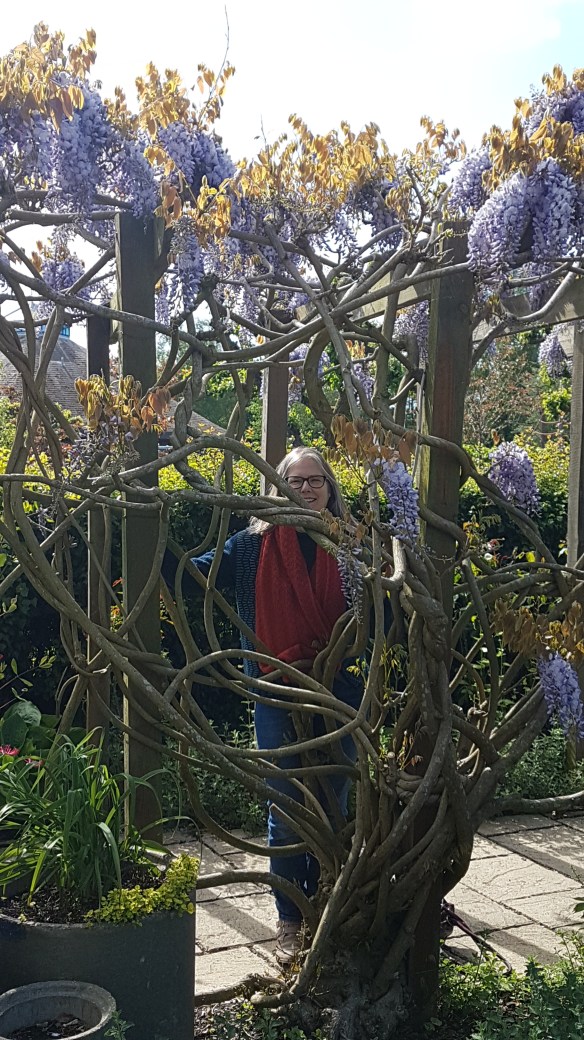
I finished knitting this a few weeks ago, but couldn’t get it photographed until today. I am glad I waited, as it has been picture perfect (despite the hail). The bluebells are out in England at the moment, as is the wisteria, and everything is bursting with colour.
It’s a long weekend here, and I’ve got something new on the needles. Good knitting, everyone!
I am so happy to have some photos of my newest hand-knit, a very chic, boxy jacket with a pattern that pops.
The pattern is designed by Hanne Falkenberg, and is called the Sofi Combi. “Combi” refers to the fact that it is knitted with two different yarns. The dark blue is a tweedy wool and the soft green is a linen blend. The two are combined in a slip stitch pattern that has an art deco feel to it. The details of the pattern are fantastic. Notice the lovely details at the shoulder, and the way the zig zags undulate at the back of the garment:
And check out the lovely faux seam at the sides:
You may also notice the (seemingly) miles of seed stitch knitted with tiny needles for the sleeves. Those sleeves were an undertaking, especially since I knitted 2.5 of them (the first sleeve was a bit baggy, so I ripped it and then did some maths and some re-designing of the sleeve cap and tweaked the decreases to get a slimmer, smoother fit.)
I have blogged about this jacket extensively over the (dare I say it?) almost TWO YEARS that I have been working on it. (Of course, in that time, I have knitted many other projects.) Now that I am actually wearing this, however, I am kicking myself for not having finished it straight away. You can see some of my previous posts on this garment under the tag Hanne Falkenberg here.
The finishing details on this garment are amazing and I have learned so much from making it. The edgings on the fronts are picked up and knit in reverse stockinette stitch, which allows the edge to roll to the back. The left photo below shows the pick up edge from the inside of the front. Along the pick up edge, you can see the edging is rolling over towards the back. The edging is then pulled over the picked up edge and sewn down, to make a beautiful, neat edge, shown on the right.
The neck is finished the same way. I am so thrilled with the finishing details on this jacket. I feel that they give a very professional look to the garment.
I have knitted two of Hanne Falkenberg’s designs previously (see my post A Tale of Two Falkenbergs for details). You can only buy her patterns in a kit, with the yarn that she provides, but I have found them to be well worth the purchase. The yarns are beautiful and Hanne’s colour sense is lovely; she often puts together colours that are surprising, but they always work. They are intellectually challenging knits (in a good way) and I have learned something from each of them.
The weather has cooperated; we are having an unprecedented warm, sunny Easter weekend in England. After posing for the above photos, I ended up knitting in the garden, and Doug thought it deserved another photo:
I am not always good with pairing patterns with patterns and so I am surprised by how much I like this jacket with this top:
When I read a blog post about a sweater, I always want to see the reverse side. So, for those knitters like me, here you can see that it is a truly lovely jacket inside and out:
Now, I am headed back to my garden to take advantage of a sunny weekend (and hoepfully to finish another project). Have a lovely weekend!
Yesterday, I finished all of the knitting on my Hanne Falkenburg Sofi Combi jacket!
What’s left to do?
Sew the underarm and sleeve seams.
Fold over and sew down the front edgings.
Fold over and sew down the neck edgings.
Weave in threads.
Wash and block.
Wear!
Here is how much blue yarn I have left after finishing the knitting:
Yes, I have been playing a nail-biting game of yarn chicken over the last few weeks. It was down to the wire with this one. As it is, I will have to unravel my swatch to have enough yarn to do the sewing. Final score: Kelly 1, Yarn 0.
The patterns that have caught my eye this week have played around with texture. I’ve been fascinated by colour and stranded knitting lately, but texture has always been my catnip. Here are some designs which are doing good things with texture, from a little taste to allover patterning.
This sweater is from the book, Art Deco Knits: Creating a hand-knit wardrobe inspired by the 1920s – 1930s by Jemima Bicknell. I love Art Deco, in architecture, in jewellery, and in fashion. The cables on this pullover are just fantastic. Set against the simple shape of the sweater, they pop! It reminds me in equal parts of a beautiful art deco building I lived near in Potsdam, and of The Jetsons, a “futuristic” animated TV show from my youth. (Now I’ve dated myself.) I think this has a cute, vintage feel to it.
I’m not surprised by this design making the list, since Norah Gaughan is the queen of texture. The shape of this one is very simple; in fact it is rather shapeless and boxy (which happens to be big news in the knitting world right now). But the asymetrical cables are mesmerising, as they shift and flow across the space. If you’ve ever been in shifting sand, you can definitely see how this pullover got its name.
This cowl pattern has a rich, luscious texture. It is named after the Sumerian goddess of grain and harvest and was inspired by memories of traipsing through grain fields. This first attracted my attention with its gorgeous juxtaposition between the three dimensional, undulating cable patterns and the flat sections worked in garter stitch with short row shaping. Having a daughter who studies ancient Sumerian, the name kept my attention focused.
This simple pullover with a great cabled yoke jumped out at me. I love that it is in sportweight rather than worsted, and looks both sophisticated and casual. I think this could be dressed up or down, and would look great in neutrals or jewel tones. (I am thinking about a rich yellow-gold.) It’s knit top-down with the increases ingeniously incorporated into the cables. This would be a quick and satisfying knit.
I am always on the lookout for great menswear. This is only the second pattern published (on Ravelry) by Vincent, the designer behind Designs by Delz. I will definitely be keeping an eye on his work. One might think that I am squeaking by here on the “texture” label, but in fact the colourwork on the yoke of this pullover combines slip stitches and purls, resulting in a beautiful subtle texture that highlights the lovely colourwork. While I classified this as menswear, it is a great unisex piece; see the pattern page for an example worn by a woman.
I’m still chugging along on the Falkenburg jacket – sleeves in seed stitch with size 2 needles take a very long time to knit. I have about 6 inches of the second sleeve still to go. Have a good weekend and don’t forget to add some texture to your next order!
(By the way, this is my 400th post! Who would have guessed I would still be doing this?)
I have made some progress on my Match and Move shawl. It is very mindless, easy knitting that nonetheless keeps one interested, particularly as the stripes introduce beautiful transitions.
However, there is one big problem. The shawl has a construction in two parts. The first part increases on both sides, widening out from the narrow point, and the second part changes up the pattern of increases and decreases to give the shawl its distinctive shape.
Martina Behm clearly states in the instructions that you can make the first part as long or as short as you wish, but you must not use up more than one third of each colour of yarn before transitioning to Part 2. Easy peasy, no?
But what happens when you are knitting in a hotel room on the other side of the globe, and have no scale to weigh your yarn? And furthermore, the shawl is looking very small to you, even if you are too lazy to transfer it off the needle and make a proper measurement? Wouldn’t you be tempted to add one more stripe before swiching to Part 2?
The pattern calls for two colours, and each stripe is 48 rows long (or 24 garter ridges). Because I am knitting with three colours, I made each stripe 32 rows long (or 16 garter ridges). In the original pattern, the pattern switches from Part 1 to Part 2 after the fourth stripe (two of each colour), so I should have switched after the 6th stripe (two of each colour). This would have been after the grey stripe on the bottom of the above photo. As you can see, I switched after the green stripe (which was the third stripe in green).
I argued with myself that (1) since I started the shawl with green, I should be able to squeeze an extra stripe out of the green despite what the instructions very clearly state, (2) I was probably underestimating the number of grams remaining and should therefore just carry on blithely knitting in the hopes that it all works out in the end, and (3) the designer was probably being overly cautious in her calculations so that if anyone were stupid enough to play yarn chicken (AHEM!) they would still come out okay.
To make matters worse, after I got home and had access to my scale, I continued to delude myself to the fact that I could squeeze out the stripes to finish the pattern, even when the numbers clearly didn’t support this! Why? Because (1) I am delusional, and (2) surely numbers lie.
Now, sadly, I have come to the conclusion that numbers don’t lie. Ripping to commence soon.
I am a real fan of fusion cooking. It’s about taking the best of two or more traditional cuisines and combining them into a single dish. As you may know, I have become very interested in Fairisle knitting, and indeed in stranded knitting techniques in general. I have spent many hours pouring over patterns and projects and admiring the use of colour and pattern and technique. One of the things that has been catching my eye lately, however, is what I am going to call Fusion Knitting – garments that are created by combining traditional knitting styles and techniques.
This design, called Heart’s Content, is by the Canadian designer Jennifer Beale. She has only released eight patterns so far (on Ravelry here), but each combines different knitting styles in interesting ways. Heart’s Content is a basic top-down, in-the-round, knitted tee, in which the lace pattern at the top and shoulders transitions to stranded knitting for the body of the garment. Not only is it pretty and imminently wearable but it has an advantage for someone who is new to stranded knitting: no steeks!
Another example of her work is the design called Joe Batt’s Arm:
I really love her poetic description of this garment (from the Ravelry pattern page):
Joe Batt’s Arm is a structured, seamed cable knit with textured fair isle banding. The fair isle bands border the eyelet cables the same way that a bright blue night encloses the Fogo Island Inn with all of its light on. At the same time, the raglan shoulders lend a sporty quality to the pullover.
I dare you to read that sentence and not to want to search for the Fogo Island Inn. I already did and I want to go there RIGHT THIS MINUTE! Check out the photo here. I love that she mentions her inspiration for this, as it really clicks once you’ve seen it. This is a very intriguing and striking garment, and I imagine it would be both fun and challenging to knit.
Another knitter who is exploring the fusion of different knitting styles is the Japanese designer Junko Okamoto. Here is her design, Astrid:
I love this pullover which combines a beautiful muted stranded pattern with cabled sleeves. Like Heart’s Content above, this is an example of a stranded garment that doesn’t need steeking. Astrid also has a loose, billowy shape – a new profile that is in counterpoint to the fitted garments of recent years, and has been championed by a crop of new (to me at least) Japanese designers of handknitting patterns. It is a one-size-fits-all garment designed to be voluminous. (I am eagerly awaiting projects of this pattern on knitters of various sizes so I can evaluate its drape and fit.)
I’m not sure whether to call it fusion knitting as such, but I am also really caught up by Junko’s Bouquet Sweater and Bouquet Scarf, both shown in the photo below:
If you look really carefully at the photos (go check out the Ravelry project pages), you can see the very interesting mix of techniques, including stranding the yarn on both the wrong and on the right side to create this ethereal, three-dimensional patterning that looks like moss on the forest floor.
I am totally captivated by these examples of Fusion Knitting and I would love to find other designers also pushing the boundaries and doing interesting juxtapositions of traditional styles and techniques. If you know of any, please mention them in the comments!
I’ve been working hard since I arrived in Johannesburg and haven’t had much of a chance to get any knitting done. Truth be told, I am quite worn out. But today is Sunday and I am not teaching, and after a cloudy start the sun came out. I cast on for the Match & Move shawl by Martina Behm. I’m still not convinced that I like triangular shawls, but I am sure enjoying knitting this:
I sat out on a lounger by the pool, put my head phones in and an audio book on (a re-read of Shards of Honor by Lois McMaster Bujold) and had a restorative afternoon. I am using yarn from a kit I bought many years ago from The Plucky Knitter. It has three skeins of Primo Fingering (75% wool, 20% cashmere, and 5% nylon) in the colours En Vogue, Faded Grandeur and Elegant Elephant. The colours are beautiful and rich:
The photos don’t really do them justice, especially when taken in the bright African light. I have very little bandwidth here (I have tried to crop the top photo at least five times unsuccessfully) so I am going to go back to my knitting and book and eke out a bit more sunshine while I can. I hope that you enjoy some time to knit this weekend, in the sun or not.