Pattern/yarn mis-match: solution!

How do you solve a mis-match between pattern and yarn?

Here’s how:

P1050065

As you may recall, I was having some troubles with my latest project.  I had picked a pattern for a pretty little summer t-shirt; the Sunbird Top by Quenna Lee.

© Interweave / George Boe

I had paired it with Carol Feller’s yarn, Nua, a rustic blend of wool, linen, and yak.  I had nearly finished knitting it when I finally succumbed to the niggling doubts that had pursued me from the beginning: I like the pattern, I loved the yarn, but they were not a match made in heaven.  The main issue was simply that the Nua is too substantial a yarn for this project.  Even though I hit the gauge exactly, the yarn was too heavy to drape properly for this t-shirt, and, let’s face it: it knits up much too warm for a summer top.

I pointed out two other problems in my post outlining my difficulties with the project.  First, the bottom edge was curling up, more than I thought would be fixed by a good blocking, and second, I hated the top-down cap sleeves, which were puckered and terribly annoying to knit:

Clearly, this yarn was not going to work with this pattern.  However, I was reluctant to rip the whole thing out so I started thinking about ways to rescue it by re-conceptualising it as a fall sweater.  Here’s what I did.

Buy some more yarn

This one made me laugh.  I pushed the button to buy the yarn just minutes before I saw the comment left on my blog post by Lorenza: “Three words: sunk cost bias…”  Yes, exactly!  So, let’s solve this by throwing even more cash at it!  My idea, however, was to turn this into a fall sweater with long sleeves which means I needed more yarn.  Since I didn’t want to try to track down the right dye lot, I decided to buy a different shade and make a colour block sweater.  I was going to go for a gold colour, but Doug convinced me to buy this olive green, which I adore.  Isn’t it a fantastic mix?

Doug said it would look like the colour transitions you get on the ocean when the depth changes, and he was right.  It reminds us of the greens and blues we saw last summer on our holiday around Vancouver Island.

Rip out the bottom 6 inches of the sweater, and re-knit with the green.

Not only did I want the sweater to have a contrasting deep border of green, but I decided right away that I didn’t want the curved edging of the Sunbird Top.  It didn’t work well in this yarn, but also it wasn’t fitting into my mental concept of what I was hoping to accomplish.  So, after ripping out a chunk of the bottom, I knit it down straight, keeping the lace on the sides, and then finishing with 6 rows of garter stitch (3 garter ridges) at the hem, to repeat the garter ridges above the chest on the original pattern.  Not only would this tie in the new design with the old, but it would (I hoped) get rid of the curling problem on the edge.  I think it turned out great.

Match the neckline finishing to the edging.

The 6 rows of garter I added to the hemline gave it a very nice finished look.  I decided to add the same around the neckline.  Not only did  it tie all of the elements together, but it raised the neckline a crucial half inch, which matters now that the sweater is a warmer-weight fall sweater instead of a breezy summer top.


Make long sleeves.

I absolutely hated knitting the original sleeves top down.  I don’t mind seaming either so the obvious thing was to knit these bottom up, flat, and then seam and set in to the shoulders.  I worried a little, since I was knitting bottom up, about getting the line matched up where the blue switches over to the green, but think I planned it out perfectly:

For those who like to know these details, the sweater measures 11.5″ from the underarm to the bottom of the blue; the green is then another 5″.  For the sleeves, I knit 6.5″ of green, and then switched to the blue for another 11.5″ before starting the underarm decreases. I do think that it stretched a bit when I washed it (gaining just under an inch in length), but it seems to have stretched evenly, as the colour transition still lines up perfectly.

I had to re-knit the sleeve cap three times before it fit properly.  The first time, I even set it in, but the armscythe felt tight and bunchy, so I ripped the seam out, and started the cap over.  I do think that the seam looks pretty good and that the cap fits much better than the original cap I was knitting top down.  If you recall, when I knit the body of the garment, I started with a larger size across the top (a 46″) and then switched to a 43 at the underarms.  This was definitely the wrong choice, and if I was being totally picky, I should have ripped the whole thing out and started again to make the shoulders narrower.  Although I think this sleeve fits pretty well, I do feel it would be a better fit at the shoulders if it were an inch narrower at each side.

While I still have a few niggles with this, all-in-all I think it is a pretty good save!  The Nua washes up great, it has a lovely silky feel to it and feels fantastic next to the skin.  It is warmer than it looks (due to the yak, I suspect), while the linen makes for a rustic look and adds depth to the colour variation (the linen doesn’t pick up the dye in the same way as the wool).  I have switched this on Ravelry from a Sunbird project to a “incorporates Sunbird” project, and have re-named it Ocean Waters.

Now, as often happens, I’ve knit a fall sweater just as summer kicks in!

On Form

I finished knitting my “form” pullover and I love it!  It is fantastic!

I love everything about this sweater.  It is comfortable, wearable, light as a feather, RED, stylish, shapely, and, oh yes, RED!  What is not to love?

The pattern, designed by Lori Versaci, is beautiful.  I had some trouble at the start figuring out how to put together the neck bands (which I blogged about here).  Lori very kindly responded to my email with a couple of photos, which helped explain the process.  Once I got that sorted out, however, and got on my way, this sweater practically knitted itself.  I am a pretty slow knitter, and this took me just under 4 weeks – and for two of those, I was practically catatonic with flu and didn’t manage to knit much at all.

The pattern has two length options and two sleeve length options.  I choose the longer length and the longer sleeve length.  I think the look is very 1960s. I have a collection of Vogue Knitting magazines from the 1960s and many of the sweaters had this kind of a feel to them.

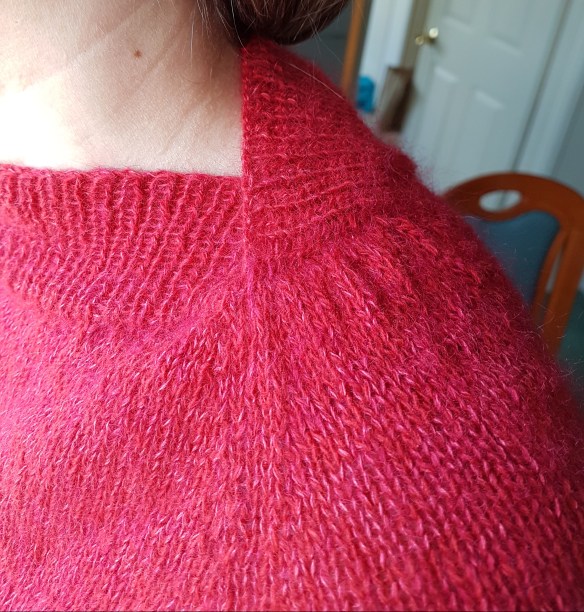
The boat neck collar is one of the cool features of this sweater.  Here is a peak at the shoulder:

Other things I love about this are the compound raglan sleeves which are perfectly formed; the armhole depth is perfect, allowing me to move comfortably and naturally and without feeling constricted.  The sleeves are roomy but in a way which I think looks chic rather than loose.  The A-line shaping in the body is lovely; and the positioning of the increases makes it drape so nicely.  Really, I love everything about this pullover.

I don’t have a lot of detail shots, because I am recovering from a bad flu; I gave Doug just 5 minutes to take some photos before I came back inside and collapsed by the fire.  It is, however, lovely in every way.  (It is also unblocked!  And I don’t think it needs any blocking.)

I followed the pattern, EXACTLY, except for two small details: I used German short rows, and I did not do the tubular cast-on or cast-off.  I used my standard, every day cast-on and cast-off.  Why?  Three reasons:

  1. I am lazy.
  2. I didn’t think it would really matter much given the mohair which makes for a fuzzy edge in any case.
  3. I am lazy.

I knit this holding two strands of yarn together.  The first is Isager Spinni, a light fingeringweight 100% wool in Red, and the second is Shibui Silk Cloud, a laceweight mohair and silk blend in the colour Tango.  I used less than 3.5 skeins of each, which means the whole sweater weighs about 270 grams.  Like wearing a cloud!

I knit it with a US7 needle, which resulted in a gauge of 21×30.  The pattern calls for 20×32.  Lori has two samples on the pattern page – one is knit with 4″ of positive ease and the other with no ease.  I was hoping for something in the middle, around 2″ of ease.  I could knit a size 42, giving me 1/2″ of ease, or a 46, giving me 4 1/2″ inches.  Given that my gauge was a bit off, I knit the size 46 and ended up with 44″ across the chest, a perfect 2 1/2″ of ease.

Because I am sick, I haven’t taken the time to dress it up for the photos, but this will be a fantastic work garment, and will also dress up nicely.  (The best I could manage today  was a pop of red lipstick and a fantastic coat!)

It has been a long time since I have knit the same sweater twice, but I am already dreaming of another “form”!

Offbeat

I’ve just remembered that I haven’t yet posted photos of my Offbeat mitts.

I am really happy with these.  The pattern was designed by Anna Elliott.  I have wanted to make them since I first saw them on Kate Davies blog here (they were designed to be  knit with Kate’s yarn, Buachaille).  There is a matching hat design, but it is the mitts which really captured my attention.  Aren’t they pretty?

They were not the easiest mitts for me to knit; the problem arising not from the very well-written pattern but rather from my lack of skills in stranded knitting on DPNs, which I discussed in this previous post.

I noted in that post that blocking produced miraculous results.  As proof, I present the below photo, showing a blocked mitt on the left, and the rather pathetic-looking unblocked mitt on the right.

The moral of this photo is to persevere; knitting is a very forgiving sport!

(If you are interested in the sweater I am wearing here and in the top photo, it is the Leyfi sweater designed by Romi Hill and blogged here.)

I knit the Offbeat mitts in Buachaille – which is a lovely yarn that becomes even more lovely with each time you wear it.  The mitts are surprisingly soft, warm, and cosy.  I took them out for a walk a few weeks ago:

I like this photo because it shows me wearing three mis-matched hand-knits, which manage nonetheless to look great together: the Offbeat mitts, my Peerie Flooers hat, and my gold Cabled-rib shawl.

For the knitting purists out there, here is the obligatory shot of the reverse side.

I highly recommend this pattern.  And if you have a chance, you should knit them in Buachaille.  It makes for lovely mitts.  (This is my third pair of mitts in this yarn.)  It is hard to describe how lofty and sheep-y the yarn is, and how nice it feels on the needles.  And look at how the colours glow in the sunshine:

I have come down with a flu bug.  My prescription?  Watch the Olympics and knit.  Sleep.  Repeat.

Home run for homespun!

Do you ever wonder what to do with little odds and ends of homespun yarn?

In the fall of 2016, Doug and I spent a few days in Wales (blogged about here) and included a stop at The Lost Sheep Company in Colwyn Bay.  There, in addition to chatting with its charismatic owner, Chrissy, and wading through waist high bundles of fleeces:

We purchased four tiny skeins of homespun yarn from Welsh bred sheep.  In the below photo, the yarn on the left was un-labelled, followed left-to-right by Jacob, Welsh Mule, and Black Welsh Mountain.

I had differing yardage of each yarn, and they were of different yarn weights.  I wondered for a long time what to do with them, and one night shortly after the New Year, I just picked up the first skein and started to knit.  I didn’t do any gauge swatches or fuss with measurements.  I didn’t do any math.  I cast on 180 stitches with a size US 11 needle and started to knit in 2×2 ribbing.  When I got to the end of one skein, I added another, and kept knitting until my yarn ran out.

As Doug was the one who picked out the yarn, I made the cowl for him.  I think it suits him well.

It is amazingly plush and cozy, and has a fantastic hand.  With the exception of the small nups of colour in the un-labelled batch, it is all un-dyed. I hadn’t knit with handspun in some time, and really loved having it on my needles.

Emma was still here when I finished, and she had just finished knitting her own cowl (blogged here), so I tried to get a photo of the two of them.  Do you have any idea how hard it is to get Doug and Emma to cooperate and not be silly?

Photo attempt #7:

Photo attempt #13:

Photo attempt #312:

Photo attempt #2,397:

This is, of course a slight exaggeration, but they delight in being silly, especially when I am trying to get a photo for the blog.

If you are trying to find a use for small bits of homespun yarn, I recommend this fun and easy solution.

The knitter’s guide to holiday enabling

For Christmas, I gave Emma a get-back-to-knitting kit.  Emma is a fantastic knitter, but suffers from lack of follow-through; her attention gets distracted by all of the other things she does well.  I had hoped that she might be tempted by having yarn and needles at hand.  My ploy seems to have worked:

I purposely picked a project that could be finished quickly; Emma knitted it in a few days.  It is called the Cecilia Cowl.  The gift consisted of a photocopy of the pattern (it is a free pattern designed by Rachel Atkinson for Loop, which you can find here), a skein of Freia Super Bulky Ombre in the colour Nautilus, and a US size 17 circular knitting needle.  I had thought that I would be around to give a hand if needed, but Emma knit the whole thing on her own, mostly during the wee hours (she arrived Christmas Eve so was very jet-lagged).

This is a great project for beginners – the pattern is easy but is also engaging enough to keep your interest.  Best of all, the constantly changing hues of the yarn make it hard to put the project down: it is a “just one more row” kind of project.

Emma is flying back to Canada tomorrow, but I am hoping that her interest has been snagged enough for her to take advantage of all of the great knitting shops in Vancouver.  I am a great enabler, am I not?

I hope that you have all had a lovely holiday, and enjoyed some relaxing knitting time.

Birthday SnowFlower

Given that it is Boxing Day, and I am about to show you a finished project, one might reasonably assume that this project was a Christmas gift.  But you would assume wrong!  Leah’s birthday falls the week before Christmas, and I knit her a SnowFlower for her birthday.

SnowFlower is a pattern by Heidi Kirrmaier, which is a yoked design using worsted weight wool.  One of the interesting features of the design is that the sweater is cast on just above the armholes at the beginning of the yoke, and knit up.  Afterwards the provisionary stitches are picked up and the body and sleeves are knit down.  This seemed like an interesting technique, and in this case, it worked out great: the yoke was shaped with decreases instead of increases (which I think have a better look to them) but the lengths could still be determined at the end by trying on the sweater.

I knit it in De Rerum Natura Gilliatt, a worsted weight 100% merino wool from France.  It is a very lofty yarn with 250 metres per 100 gram ball.  The yarn is very reasonably priced, and with this excellent yardage, it comes in at just over half the price, metre for metre, of Brooklyn Tweed.  (Note that I live in the UK, where it is likely that Brooklyn Tweed is more expensive and De Rerum less expensive than in the US.)  I found it to be a very nice yarn to work with and produces a great, soft, lofty fabric.

I am very happy to put it on my list of great workhouse yarns, as it is nice to sometimes knit things with reasonably priced yarns.  The only complaint I have so far of the yarn is that the colour palette is limited.  I would have loved to have a bit more choice.

There are many great examples of this sweater on Ravelry.  I was particularly inspired by two beautiful examples knit by SmashingPuffin.  I am glad that I followed through because it was a delight to make, and very quick.

I wrote a few blog posts about trying to pick the right colour combination for this sweater.  I really think I nailed it in the end.  I am totally pleased with these colours.  I think that it looks very Norwegian.  The combination of the cheerful snow flowers of the pattern and the lively pop of red, make for a beautiful winter sweater.  It is both warm and cozy, and sunny and bright.

I knit the sweater exactly according to the pattern.  The only change I made was to add an additional 4 stitches under each sleeve (picking up 18 instead of 14 stitches).  The knitting took no time; I finished in about 5 weeks.  I managed to finish it in time for Leah’s birthday, but then she decided she wanted it an inch longer, so I ripped out all of the ribbing on the body and the sleeves, knit an extra inch of stockinette and then re-knitted the 3″ of ribbing.

Doug said “Why didn’t you just make the ribbing 4″ long?  That way you wouldn’t have had to rip and re-knit all of that rib.”  The truth is it never would have occurred to me to do that.  One of the things I like about a hand-knitted sweater is that you knit it so that it is exactly right.  If you wanted a sweater that wasn’t exactly right, you could buy it.  Ripping and re-knitting, so that your garment turns out exactly how you want it to, is one of the joys of knitting.  Call me crazy, but that’s how I feel!

We photographed this sweater today, on a fairly grey, wet Boxing Day in the beautiful village of Turville, which is frequently used as a film site.  Can you see the windmill up in the top of this photo?  It is the Cobstone Windmill located in the adjoining village of Ibsden, and which was used in Chitty Chitty Bang Bang.  (It was the home of inventor Caractacus Potts.)

This photo shoot was a family affair (just like old times!).  Emma is home and so she took the photos for this post.  Here is a shot I took of her doing the photo shoot:

We took some silly shots:

And here is a picture of me, pushed to the sidelines by Doug, Emma, and Leah (in a bid to keep me from micro-managing the process).

Happy holidays! And happy knitting to all!

In the thick of it

As a knitter it is very important to take care of your equipment.  And what piece of equipment could be more important than your hands? As someone who has a history of hand and wrist problems, including repetitive stress injuries, I am always trying to be cognizant of maintaining good practices for hand health. I think that it is better for your hands to be alternating between different kinds of knitting, and in particular between different weights of yarn and needles. In that vein, I decided to cast on something using a thick yarn.

I tend to prefer knitting with lighter weights, but I had bought this yarn last fall with the intention of making a quick Christmas gift, and then never got around to it. It is incredibly soft and is in a very vibrant and saturated purple.  I love how the chunky yarn in a heavily cabled fabric makes such great texture – it results in beautiful hills and valleys bursting with light and shadow.

The yarn is Whitfell Chunky by Eden Cottage Yarns, a 100% baby alpaca in the colourway Damson.  The pattern is the Umbra cowl designed by Louise Zass-Bangham. I tried this cowl on at a wool fair last year, made with this yarn, and it was wonderfully cozy; I bought some on the spot.

Do you know the other advantage of knitting with chunky yarn? It takes no time to finish something!

This cowl took a few short evenings of knitting. The pattern is intuitive and doesn’t require much attention.  It is good TV knitting, or carrying-on-a-conversation knitting. The only difficult part was grafting it together.  Here I will let you in on a secret: I suck at Kitchener stitch!  Really, this is on my list of knitting techniques that need major work.  I inevitably end up with more stitches on one needle that the other. (Many more than the one stitch you would expect.)  If I stop concentrating for even a second, something goes wrong.  Here you can see how lousy I am at Kitchener; look at this terrible join:

Oh my! Quelle horreur! Am I going to let my knitting perfectionism take control and force me to rip it out and re-graft, and then re-rip it out and re-re-graft, and then re-re-re-rip it out, etc. etc? No, I’m not.  It’s staying this way! A New Kelly is evolving!

Having had a week in the thick of it (knitting-wise and otherwise in fact), I will return to my colourwork fingering-weight jacket with happier hands.  I hope you are safe and dry this weekend.

A pattern to celebrate my 300th post!

This is my 300th post on this blog!  I am very excited to still be writing the blog, and happy that people keep reading it.

To celebrate my 300th post, I designed and knit a beautiful, colourful shawl and have posted the pattern here for you.

I had three goals in mind with this pattern:

  1. It had to be in garter stitch. (Mindless knitting, yeah!)
  2. It had to use yarn already in my stash. (Limited funds, boo!)
  3. It had to match my COOL BOOTS! (Cool boots, yeah!)

(The boots are from Camper.)

Here is a photo of it laid flat:

I love this shawl.  It is a deceptively simple pattern, composed of long, thin triangles, but once it’s off the needles it has fabulous drape and the colour pops!

Please enjoy the pattern.

Cool Boots: a shawl pattern by Kelly Sloan

The shawl is knit lengthwise in garter stitch, with six very long triangles formed with short rows.  Please read the pattern through before knitting, particularly the Notes at the end.  You should review the instructions for German short rows in garter stitch (which you can find in this post on the blog).

Size: Approximately 18” x 70”

Yarn: Fingering weight wool in three colours; approximately 70 grams (350 meters/383 yards) of each colour.  For this shawl I used Tvinni Tweed by Isager in shades 17S, 28S, and 32S.  These are 100% wool tweed yarns in shades of red, coral and fuchsia, with a grey tweed undertone.

Needles: US 4 (for the shawl); US 6 (for casting on and binding off)

Gauge:  24 stitches and 48 rows (24 garter ridges); very lightly blocked.

When I took the shawl off the needles, it measured 16.5″ x 64″.  I very lightly wet blocked it to 18″ x 70″.


Directions.

With Colour A and US 6 needles, cast on 380 stitches.

Switch to US 4 needles.

Triangle 1:

Row 1 (RS) – knit 2 rows.  (You will have one garter ridge on RS of work).

Row 3 (RS) – knit to 12 stitches from end, turn work.

Row 4 (WS) and each remaining (WS) row – slip first st as if to purl, pull yarn to the back, knit across all remaining stitches (you have thus performed a German short row; see Notes).

Row 5 and RS rows: Knit until 12 stitches from the last German short row (indicated by the “double stitch”), turn work.

Continue until 18 stitches remain before the last German short row.  (This number could vary depending on how you count your short rows.  Continue until you have between 12 and 24 stitches before last short row.)

Next row (RS) – knit all the way across, knitting each ‘double stitch’ together as one stitch. (See Notes for German short row.)

Next row (WS) – knit all stitches

You should now have two garter ridges at the narrowest edge of the triangle with the right side facing you.  At the wide edge, you should have 32 garter ridges (note that this number is not important, but it should be the same for each triangle.)

Triangle 2:

Change to Colour B.  Knit 3 rows, ending with a RS row.  You should have one garter ridge with Colour B with the right side facing.

Row 4 (WS) – Knit to 12 stitches from end, turn work.

Row 5 (RS) and each remaining (RS) row – slip first st as if to purl, pull yarn to the back, knit across all remaining stitches (you have thus performed a German short row; see Notes)

Row 6 and WS rows: Knit until 12 stitches from the last German short row (indicated by the “double stitch”), turn work.

Continue until 18 stitches remain before last short row (or same number of stitches as for last triangle).

Next row (WS): knit across all stitches, knitting each ‘double stitch’ together as one stitch.

You should now have two garter ridges at the narrowest part of triangle 2, when viewed from the right side.

Repeat these instructions twice more, thus making a total of 6 triangles, changing colours as indicated in the chart.

With RS facing, and using a US6 needle, cast off all stitches.

Finishing: Weave in ends.  Wash and block lightly.


Notes

Note 1.  Weigh your yarn.  At the end of the first triangle, weigh remaining yarn of Colour A.  You will need enough yarn for two triangles in each of the three shades.

Note 2.  In the beginning, mark the right side (RS) of work with a removable stitch marker.

Note 3. All colour changes are made at the beginning of a RS row.

Note 4.  The narrow edge of each triangle has two garter ridges.  The first of these is made before you begin the short rows; the second garter ridge is made at the end of the triangle, after the short rows, when you knit across all of the stitches.

Note 5. On the first, third and fifth triangle, the short rows are made (the work is turned before the end of the row) on the RS rows; on the second, fourth, and sixth triangles, the short rows are made on the WS rows.

Note 6.  There is a photo tutorial of how to do German Short Rows in garter stitch on my blog.  You can find it in this post.  This is by far the easiest way to make short rows in garter stitch, and should not leave any holes in your work.

Note 7.  Put a removable stitch marker into the ‘double stitch’ formed by the German short row.  After each short row, you can move the marker, so it always marks the last short row knitted.  This makes it easier to know when to turn on the next turn row.

Note 8.  When counting the 12 stitches between short rows, I counted the ‘double stitch’ from the previous short row as stitch number 1.  This is illustrated here:

Note 9. You can make the shawl shorter or longer by casting on fewer or more stitches, respectively.  You can change the width of the shawl by increasing or decreasing the number of stitches between each short row (the more stitches between short rows the “narrower” the triangle will be).

That seems like a lot of Notes, but the pattern is very intuitive and easy peasy.  Please enjoy!

This shawl has not been test knitted.  If you find any mistakes, or have trouble understanding any part of it, please let me know.  You can leave a question on the blog, or you can write to me on Ravelry (my Rav name is kellydawn).

A final note: Please respect my copyright.  Do not reproduce or publish any part of this pattern without my permission.

Silk and sunshine

Some time ago, I bought myself a single skein of Shibui Knits Silk Cloud, a mohair and silk blend lace-weight yarn in the brilliant shade called Tango.

I am a big fan of Rowan’s Kidsilk Haze and have knit many things with it.  But I was curious about the Silk Cloud.  The Silk Cloud is more expensive. However, it has a higher silk content – 40% in the Silk Cloud compared to 30% for Kidsilk Haze. Most important to me, the colours of the Silk Cloud are glorious – brilliant, richly saturated tones.  Kidsilk changes its colours frequently and the last time I checked I found their palette to be rather pale and uninspiring.

I decided to knit a little cowl using a free pattern available on Ravelry called the Madita Cowl, designed by spacecurry.

This was an airplane knitting project, knit entirely while in the air (or the airport lounge). I used plastic needles (so as not to upset security), and the whole project was so small and lightweight that it fit easily into a pocket.  I actually did not enjoy knitting it, although not for the reasons you might suspect.  The yarn is lovely, as is the pattern; the truth is that I hate knitting with laceweight yarn on big needles (a US9).  I complained about this on these pages before, when knitting the beautiful Smoulder sweater for Emma, which uses a double strand of Kidsilk Haze but it is knit in part with size 15 needles. I think perhaps continental knitters might find this easier, but as a thrower, I find it very awkward.

The cowl itself is gorgeous, although a bit of an enigma.  You see, it is too short to wrap around the neck twice, and too long to provide any actual warmth to the neck.  This makes it essentially a bit of frippery (although a pretty one at that).  I believe that if I were to knit it again, I would make it longer, so that it could be wrapped twice.

Now that I have had my little experiment, I can say that there will be more Silk Cloud in my future. The only difficult task will be not buying one of every shade.

When you need a rainbow…knit one!

I wanted to do a quick project this week.  I rooted around in my yarn stash and found a bag full of half-used balls and remnants of Rowan Fine Tweed.  I really like this yarn and used it to knit my Peerie Flooers hat and my Soumak Wrap, both very colourful projects, meaning lots of bits of many colours leftover.  Rowan has now discontinued this yarn, carrying on its great tradition of discontinuing nearly every yarn I love (knock on wood for Kidsilk Haze).

I had in mind a quick pair of mitts based on Follow your Dreams, a very cute pattern available for free on Ravelry by Vlněné sestry.  Here is the pattern photo:

© Vlněné sestry

I spent some happy time playing with all of the leftover colours when it came to me: I could knit a rainbow!

I used a light grey for the background and picked out five rainbow shades for the arrow motifs.  I didn’t think I had enough of the grey, so I knit the ribbing around the wrists in rainbow stripes as well.  The colours are reversed, so the wrist ribbing uses red, orange, yellow, green and blue, and then the arrow motifs work in reverse order from blue to red. Thus, the mitts are framed by the red.  At the time, I had no inkling that the red would match my beloved Acer cardigan so well, but I think that together they are fabulous!

The only other modification I made was to make the mitts mirror images of each other (so that the arrows point in opposite directions).  I loved making this project.  I could easily imagine knitting up many pairs of these, using lots of different colour schemes.  It is a great project for using up small bits of fingering weight yarn.  Using stripes for the ribbing meant many extra threads to weave in at the end, but it was totally worth it.

Some time ago, I wrote a post about the use of gussets in mitts and mittens.  In that post, I mentioned that I had always knit mitts with gussets, and I speculated that gusset-less mitts would be uncomfortable to wear.  Based on my lengthy observation consisting of wearing this one pair of mitts for a few hours (how scientific!) I would venture to say that gusset-less mitts can indeed be comfortable.  I will now have to do more research on the topic, thus necessitating knitting more mitts.  All in the name of science of course!

We took these photos this morning in Henley-on-Thames, a beautiful old market town on the Thames a few miles from my home.  (I work there and shop there.)  The sun was shining and everyone was smiling; it was a perfect day to walk along the river and to wear my new cardi and rainbow mitts.

I wish you all sunshine and rainbows this weekend!