Aces!

p1020228

I’m very happy to have finished my Acer Cardigan while it is still cold enough to wear it. The above photo was taken last weekend in Copenhagen.  It is such a gorgeous city, but can be very windy.  A squishy, warm cardigan definitely comes in handy.

Amy Christoffers designed the Acer Cardigan in 2010 and nearly 900 projects are documented on Ravelry.  When you get that many knitters using a pattern, you know in advance that the pattern will be good and won’t need any “fiddling”.  I followed the pattern exactly; the only modifications I made were to knit it one inch longer (and use two extra buttons), and also to cast on more stitches for the edgings (see below for details).

p1020274

I used Berroco Ultra Alpaca, a worsted weight yarn that is a 50/50 wool and alpaca blend.  It is a very sturdy yarn and has good definition; this latter is very important for this pattern which combines cables with lace.  I am still not sure what I think of the yarn.  It comes in lovely, rich colours, works cables beautifully, and comes in at the inexpensive end of my yarn buying spectrum.  On the other hand, it is a bit itchy and I am worried that the alpaca might become “fuzzy” with use.  I will need to wear it and wash it a few times before I can pass judgement.  Here you can see the great stitch definition:

p1020277

I knit this in a size 42 and find the fit to be spot-on, with about one inch of positive ease. The shoulders fit really well, although I find the sleeves to be a bit tight.  I like the fact that I can button it with no gapping.  I used a US 6 needle and US5 for the button bands and neck ribbing.

I found only two problems with the pattern, fairly minor ones, but useful to know about in advance.  Although Amy lists two needle sizes at the top of the pattern, noting that the smaller size is for “edging”, she doesn’t actually note within the pattern itself to switch to the smaller needle when knitting the button band and neck edgings.  This is a VERY niggling point, but I see on Ravelry that many knitters didn’t switch and wish they had. The other problem is actually a small error in the pattern; she has you pick up stitches along the neck by a factor of four, but you actually need a factor of four plus two, so that the ribbing will both begin and end with two knit stitches.  I picked up more stitches than the pattern called for: in my size, she suggests picking up 83 stitches for the button bands and I picked up 103 (though recall that I added an inch to the sweater length), and for the neck I picked up 118 instead of 108.

Here is a photo in front of the Copenhagen Contemporary Art Gallery.  I am standing in front of the exhibition Wish Tree Garden by Yoko Ono. (If you are by chance in Copenhagen during the next two weeks, I loved this exhibit, which will close on the 5th of March.) Thanks to Erun for taking the Copenhagen photos.

p1020224

I love the buttons I picked.  I had planned to use a pair of plain wooden buttons, but saw these and instantly thought they’d be perfect.  (I bought them at Loop in London.)  I think they add just a bit of flash to the cardigan.

p1020281

This was the second worsted weight cardigan I’ve knit in a row (the first was the Tinder cardigan I knit for Emma).  Unlike Tinder, this cardi flew off the needles; it took me 6 weeks to the day to knit, even including washing and blocking and sewing on buttons. This made me think “I need to knit more worsted weight sweaters”, but now that I have been wearing it, I must say that it is VERY warm.  I think that my next few sweaters will use a fingering or sport weight wool.

It is a dreary day here in England.  I must admit to loving dreary Saturdays – no feeling guilty for knitting all day!  Happy weekend!

Pretty much perfect in every way

I’ve written a lot of posts about the Tinder Cardigan that I have been knitting for Emma. Some of them funny, some of them frustrated, and many of them nit-picky.  But, I have to say, this cardigan is really worth the effort.

p1020026

I fretted about the seaming, complained about the yarn, worried that it wouldn’t fit, dragged it around the world and back and then back again, had ridiculous conversations with Emma about whether and how to modify it, ripped out seams, blocked it TWICE, bought three different sets of buttons, knit it in four countries on three continents, and………

it is pretty much perfect in every way.

p1020156

I will leave you to read through my earlier posts for in-depth details.  The cardigan was designed by the great Jared Flood for Brooklyn Tweed (the Ravelry link is here).  I used Shelter worsted weight yarn (also from Brooklyn Tweed) in the shade Birdbook. Despite the fact that it is not my favorite yarn to knit with (I don’t like the feel of it in my hands), once washed and blocked it really delivered!  It is so light and lofty and has one of the best tweed palettes anywhere.

p1020007

I knit it in a size 34 planning on an inch or two of ease; my gauge swatch lied a bit (that’s my story and I’m sticking to it) and it ended up being REALLY narrow.  I blocked it out twice in order to get more width, particularly in the collar and biceps.  It ended up with zero ease – not the look we were going for – but both Emma and I agreed that it looked fantastic this way.

p1020161

I made very few modifications.  I knit it two inches longer than called for – both in body length and sleeve length.  I knit the ribbing for 6 inches (instead of the 4.5″ called for).  I put in more buttons (9 instead of 7), and they were also slightly larger than the pattern called for (1″ as opposed to 3/4″).   I found a beautiful ribbon which has a pattern in the very same shade of green, and I painstakingly sewed it over the pick-up seams on both the button and the button hole band.  My hope is that the ribbon will give the cardigan some stability over time and keep it from stretching out of shape.

p1020155

I took the unfinished cardigan with me to Vancouver, where we were spending the holiday with our daughters.  While there, I knit the button bands, picked out buttons with Emma (at the funky shop Button Button), sewed on the buttons, and then, as said before (but it demands repeating) painstakingly sewed on the ribbon.

p1020028

On New Year’s Day, we drove up the coast, first to Horseshoe Bay and then farther up towards Whistler.  The day was stunning with blue skies and fabulous scenery, but it was icy cold and extremely windy.  In fact, the road into Horseshoe Bay was covered with downed branches and we nearly drove under a tree just as it crashed onto the highway during the drive. As you might expect from our family, we made Emma get out of the car in the freezing cold and gale force winds – repeatedly – in order to photograph the sweater. The things we do for this blog!

p1020014

On the photos we took during that drive, you may notice that the cardigan has no buttons or ribbon yet, thus compounding the child cruelty in making Emma pose in the cold and wind!  Once we headed back into Deep Cove, I sat by a roaring fire and started to sew.

p1020046

As always, when Doug and I find ourselves in Vancouver, we head down to Deep Cove to take a photo of us on the spot where we were married.  Here we are, at the very spot, a mere 25 years (and a few months) later!

p1020097

Cowl-a-bunga!

p1010886

This year I knit cowls for Emma, Leah and Doug for Christmas.  Today the sun came out in Vancouver and revealed the city in all of its glory.  We went down to Stanley Park to take some photos and enjoy the day.

p1010755

Emma’s cowl is designed by Isabell Kraemer, and is called Copenhagen Calling.  It is a really beautiful pattern and produces a big, lush cowl.

p1010779

I knit it with two shades of Triskelion Elmet Aran which I bought at Yarnporium, a lovely event organised by the folks at the Yarn in the City blog.  I was entranced by the Triskelion display, which had a veritable rainbow of gorgeous shades.  The yarn for both Emma’s and Leah’s cowls was purchased from their booth.

p1010863

Emma’s cowl is in grey and burgundy; the colours are rich and deep.  The yarn is very wooly and sturdy – it has substance and feels good in the hands while knitting.  I was surprised by how well it bloomed in the wash, producing a lovely, lofty, warm fabric.

I purchased one skein of the grey and two of the burgundy; each skein has 160 meters. The pattern calls for 250 meters of the first colour and 330 of the second.  I adjusted the pattern slightly to make up for my lesser yardage.  I cast on with the grey, using US7 needles, and ribbed for 2.5″.  I knit only 2.5 repeats of the slip-stitch pattern (instead of the called for 4 repeats), which brought me to the end of the grey yarn.

p1010830


I made a slight change in the pattern, in that just before starting the lace stitch, I decreased 8 stitches evenly around.  Many of the photos I have seen of this cowl have a very stretched-out lace section and I was hoping to avoid this.  I knit the lace on a US6, and then knit the garter rows with a US5 (as per the pattern).  I think the result is perfect.

Unblocked the cowl measured 44″ x 10.5″. I blocked it out quite a bit to open up the lace – it ended up at 50″ x 11″.  I could not be happier with the pattern or the yarn; the combination of the two is fantastic and looks beautiful on Emma.

p1010874

For Leah’s cowl I used the pattern Slip-Zag by Lisa Hannes.  I had wanted to make this cowl for a long time and had always envisaged it in green and purple.  The Triskelion display at Yarnporium had the most stunning array of greens and purples; it drew me in immediately.  There were many beautiful yarns on display at this event, but I found myself unable to walk past their booth.

p1010784

I used a DK weight for this cowl, which is knit in Triskelion Dyfnaint DK, in the colours Llyr and Cepheus.  I had initially chosen a more grass green shade, but upon discussion with the booth attendant, I went for this teal. These two were made for each other – the incredible jewel colours become even more vibrant when paired together.

I cast on 260 stitches and used a US6 needle.  The pattern is very intuitive and relaxing. I knit this while on holiday in South Africa and found it a very enjoyable knit.  Like the Elmet Aran, the Dyfnaint blocks beautifully.  It is wonderfully soft and warm.  I will definitely be using these yarns again.

p1010820

Doug received his cowl a bit early, and I blogged about it here; the linked page includes the free pattern for the design, which I call the Business Class Cowl.  These photos, with the late afternoon sunshine, really bring out the beautiful colour of the cowl.

p1010788

It is knit with Woolfolk Tynd in Darkest Bronze; the sun picks up the bronze shade perfectly.

p1010882

It was good to end out the year exploring new yarn companies; I had never used either Woolfolk or Triskelion before.  They both make fantastic yarns and I already have projects in mind for each.

We had a beautiful day in Stanley Park.  This was in many ways a very trying year and it was good to end it with the four of us being silly together on a lovely day.

p1010825

I normally end the year with a summary of the year’s knitting.  I will definitely do that, but will likely post it a few days into the New Year.  In the meantime, I wish all of you a healthy and happy New Year, with lots of knitting and with a renewed commitment to compassion, human kindness and a just and democratic society.

Happy New Year from me, Kelly, and from my co-conspirators, Doug, Emma and Leah!

Five countries, three continents, one cardigan!

I have been holding off showing photos of the cardigan I knit for Leah until it actually arrived in Canada.  It is taking forever to get there, however, so here we go.  Unfortunately, Leah is not around to model it (thus the need to ship it to Canada), so I have had to model it myself.

P1000751

I started knitting this cardigan in England when the girls came home for a short break.  I knit most of the back piece in Sicily where we had a great holiday (see the photo below of me knitting it on the lawn of the beautiful villa we holidayed in).  I knit one front in my hotel in Malaysia, where I had traveled to do some teaching for the business school.  I knit part of the other front in Singapore, where I met up with my friend Erun for some fun.  I knit the sleeves back home in England.  I took it with me to Johannesburg, where I was again doing some teaching for the business school.  I did some of the finishing there, knitting the neck and one of the button bands.  And then I finished it back home again in England, where I agonized over button bands and general finishing issues.  FIVE COUNTRIES, THREE CONTINENTS, ONE CARDIGAN!

20160516-P1000067

I used a pattern from Amy Herzog’s book, Knit to Flatter, with the not very romantic name of Squared Cardigan.  I had purchased 4 skeins of Madelinetosh Pashmina in the colour Plunge, but only needed three to make the cardigan!  (I used every bit of those three skeins.)  I made a few modifications.  First, following Amy’s advice in the book on options for bust shaping, I ended up knitting the two front pieces in a size larger than the back. This gives extra room for the bust and belly without making the cardigan too big across the back and shoulders.  I think this was a good choice.  I won’t really be able to tell until Leah gets to try it on.  I am modelling it here, and Leah and I are close in size, but she is broader in the bust and shorter in the waist than I am.

P1000774

I also changed the neckline.  Amy’s pattern has a rolled neck, but I put in three rows of seed stitch instead.  Other than these small mods, I knit the pattern as written (how unlike me!).

P1000795

My biggest problems were with the finishing.  I really struggled with the button bands (as documented here).   I decided to sew ribbon to the backs of the button bands and then to use plastic snap fasteners; the buttons are for decorative purposes only.  I’m not entirely happy with this solution.  Doug thinks it would be better with a zipper, and my mom suggested keeping the decorative buttons, but adding hook-and-eye fasteners (instead of the snaps).  Both of these solutions would be good, probably better than what I ended up doing; but honestly, I was so tired of being undecided and wishy-washy and just wanted to get the thing finished and put it in the post.

P1000743

One of the things that makes this cardigan distinctive is the textured pattern on the cuffs and waistband and the way that it curves.  I found this to be very fiddly.  I think that it looks pretty but I don’t feel it was worth the time and effort.  If I made this again, I would just put in ribbing, or better yet, seed stitch.

P1000739

The yarn is beautiful, but I did feel that there was a big colour difference between some of the skeins; in particular, the back is a noticeably different shade than the fronts and sleeves.  I could have fixed this by alternating skeins, but I really didn’t want to do that, especially since I was lugging this thing around the world with me and knitting it on planes and in airports.  I also worry that the yarn has too much drape for this cardigan.  If I were to knit it again, I would use a yarn with more wool content and less silk.  I would also make the neckline higher by an inch or two.

P1000797

So, the conclusion is mixed.  I think it is very pretty; the yarn is lustrous, and the buttons and ribbon are a perfect match.  But, I have some niggling issues with the finishing.  I think, for me, I will chalk it up as a learning experience.  Hopefully, for Leah, it will be a lovely summer dressing option and will get lots of wear.

P1000792

What the best dressed baby is wearing: the urbane hipster edition

Those who know me will tell you that I rarely knit for babies.  Even when my own girls were little, they rarely benefited from the fruits of my knitting needles.  In the nearly five years that I have been writing this blog, I haven’t knit a baby sweater. Until now.

P1000677

I have some friends who have just had their first baby. These friends are special, and thus obviously so is the babe. Clearly he deserved a bit of stylish hand-knitting intervention. I perused baby patterns for quite some time. With Doug’s help, I finally decided on the pattern called gramps, designed by Alexa Ludeman and Emily Wessel, the duo otherwise known as Tin Can Knits. Here is their delightful version:

9M-gramps-27_medium2 (1)

© Tin Can Knits


I made a trip into London to my favorite yarn store, Loop, in Islington (which also necessitates buying cakes at Ottolenghi – poor me! how I suffer for my knitting!). I spent a very long time trying to choose the perfect colours of Madelinetosh Vintage, which we all know is a very luxurious hand-dyed worsted weight wool. I purchased two beautiful skeins: Turquoise, which to my eye is more a forest-y green/blue than an ocean-y green/blue (to use sophisticated colour terminology) and Pecan Hull, which is a lovely but difficult to photograph brown.

P1000670

I bought the yarn without purchasing the pattern first (or even looking at the yardage stats on Ravelry). I bought one skein of each colour – after all, this is a sweater for a baby; how much yarn could you possible need? Imagine my consternation to discover that in the 6-12 month size, this little sweater eats up 260 yards of the Main Colour and 140 yards of the Contrast Colour. A skein of Madelinetosh Vintage is 200 yards.  Whoops!  (Even in the newborn size, I would have needed 240 yards of the Main Colour.)

P1000674

Luckily, we knitters have a solution to problems like this: it is called MATH!!!!  Yes, dear readers, I engaged in a bit of “Pattern Math Fu” to re-design the sweater.  Note that the original pattern calls for a total of 400 yards of yarn.  Note further that I had 400 yards of yarn.  All I had to do was change the pattern sufficiently so that it had a more equal distribution of the colours.  This, I must admit, was rather fun, and I think the end product is completely lovely in every way.

P1000664

I followed all of the instructions for the 6-12 month size exactly, except that I omitted the pockets and elbow pads, and added in seven sets of 2-row stripes on the body and sleeves of the sweater.  Here you can see the yarn that remains:

P1000687

I had so much fun knitting this little sweater.  We actually had a week of decent summery weather (egads!) and I enjoyed the chance to knit in the back garden while listening to a good book.

P1000685

Photos don’t do this sweater justice.  It is absolutely fabulous. It is the perfect sweater for the urbane hipster baby to wear while sitting at his favorite coffee shop charming all the passersby.

P1000667

This pattern also comes in adult sizes.  Resistance is futile.

Gilded paradise

P1000321

I finished my gold shawl weeks ago, but waited until I was in Sicily to photograph it.  We were staying in an absolutely fantastic villa, called the Commenda di San Cologero, which is beyond gorgeous.  (It also has the nicest, most friendly staff you will ever meet.  I’ve stayed there twice now, and hope to return soon.)  It is on the eastern coast between Catania and Syracusa.  As you can see from these photos, it was a most beautiful backdrop for this lovely piece of knitting.

P1000320

The pattern is the #02 Reversible Cabled-Rib Shawl, by Lily Chin and originally from Vogue Knitting, Winter 1999/2000.  It can now be found on-line as well; check the Ravelry pattern page here for details.

P1000350

The shawl is knitted in the now discontinued yarn, Kidsilk Haze Eclipse, by Rowan Yarns in the colour Virgo.  It is a very lovely shade of beige gold.  If you don’t have any Eclipse saved up, don’t fret – Kidsilk Haze is readily available and works perfectly for this pattern.  (I have previously knit this shawl in Kidsilk Haze in a vibrant green, which you can see in this post.)

P1000322

Many people have commented on the repetitive (and endless) nature of this pattern.  If you look over the projects on Ravelry you will see that I am not the only one who called it “boring”.  (Although there are those who find it “meditative”).  It is essentially a very big shawl knit in 2×2 ribbing in lace-weight yarn with cable crossings every 12 rows.

P1000317

The first time I knit this pattern it took me 20 months to finish – it was so boring, I kept putting it aside to knit other things!  I finished this one in just over 4 months.  Perhaps this relative speed is because, having worn the green one countless times over the years, I know that the benefits outweigh the effort.   Perhaps, I am simply in a more “product knitting” place right now.  Or, dare I say it, perhaps I have been too lazy to cast new things on and thus managed to power through.   Whatever the case, the end product is absolutely worth it.

P1000342

In the above photo, Emma is wearing another project of mine, the Viajante shawl, which I knit in 2013; this was another endless, repetitive knit in lace-weight that produced a magical garment.  (We photographed this piece in Sicily as well; it will feature in an upcoming Wearability Wednesday post, so keep your eye out for it.)  Today just happens to be Emma’s 23rd birthday – Happy Birthday, gorgeous!

I am still planning a long travel post for you with lovely photos of our adventures in Sicily. It will have to wait until I get home, however.  I am, rather ironically, writing this post in the middle of the night in my hotel room in Malaysia while suffering terrible jet lag.

P1000337

See that smile in the above photo?  Well, you would be smiling, too.  It was the best holiday ever!

Spring green mitts

IMG_1928

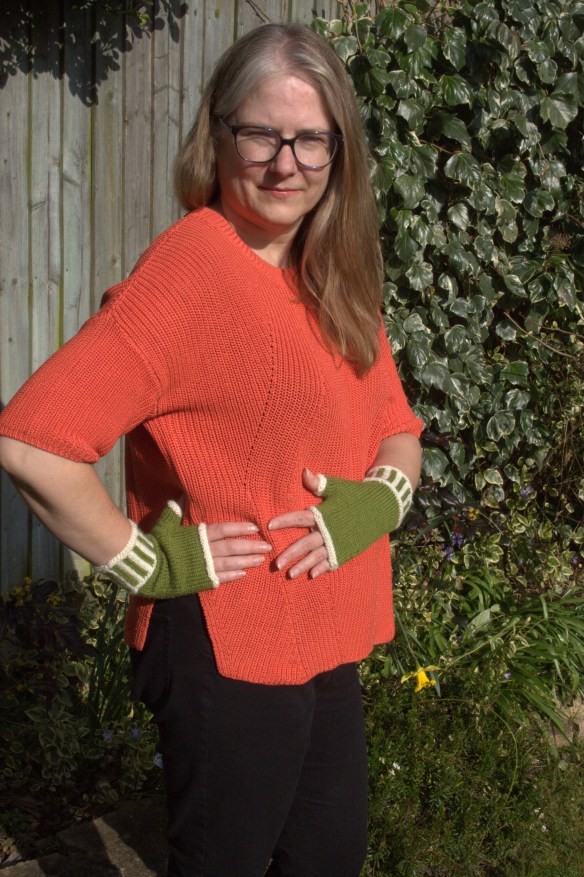
I am now back in England and we had a beautiful hour or two of sun this afternoon (!) in which to take some photos of my new mitts.  These are the mitts which I was knitting last week while in South Africa communing with elephants.

IMG_1925

This is the pattern Wedgewood Mitts, designed by me.  I designed them to play around with a lovely shipment of Kate Davies’ new yarn, Buachaille.  The original pair, made for Leah, was in a very pretty mid-blue with white edging.  Just before leaving for Johannesburg, I tossed a skein of this lovely spring green, called Yaffle, and the remaining white from the first pair of mitts, into my suitcase.

I made a few small modifications from my original pattern.  Here is what I did:

  1. Cast on an extra 4 stitches (48)
  2. Worked an extra two rows of corrugated ribbing
  3. Decreased 4 stitches after ribbing
  4. Worked an extra 2 rows before starting gusset
  5. Worked three rows less before adding white edging

Basically, this added 4 stitches just to the cuff, to make the cuff a tiny bit more roomy.  I also made the cuff portion of the mitt slightly longer, while making the finger portion of the mitt slightly shorter.

IMG_1926

I am very happy with how they worked out, and am especially charmed with the combination of this spring green and the white (Yaffle and Ptarmigan in Buachaille-speak).  Obviously, I am not the only one to think so.  I had finished the first mitt and cast on for the second when I noticed that Kate Davies had designed a new hat for release at the Edinburgh Yarn Festival this weekend:

small_funyin19_medium2

© Kate Davies Designs


I absolutely love this design, which was inspired by a collection of Hornsea pottery designed by John Clappison in the 1960s; go read Kate’s post here.  Sadly, I cannot be at the festivities in Edinburgh this weekend, but I did try to alleviate my misery by ordering a kit to make this hat!  Just think how pretty it will look with the mitts.

IMG_1931

Happy Sunday everyone!


if at first you don’t succeed…

IMG_1910

Recently, I have been seeing lots of pom pom hats.  Each time I think “Poms poms may be cute, but they are not for me.”  I don’t remember wearing them the last time they were in vogue, and I was younger and cuter then.  But I suppose my contrary nature got the better of me, because I saw a photo on Ravelry of an un-modelled hat with pom pom, made from The Uncommon Thread Lush Worsted (one of my favorite yarns) in Cobble (one of my favorite shades) with a beautiful, soft, fluffy (and very large) alpaca pom pom.  Within minutes, I had ordered the yarn and pom pom.  How does that happen?

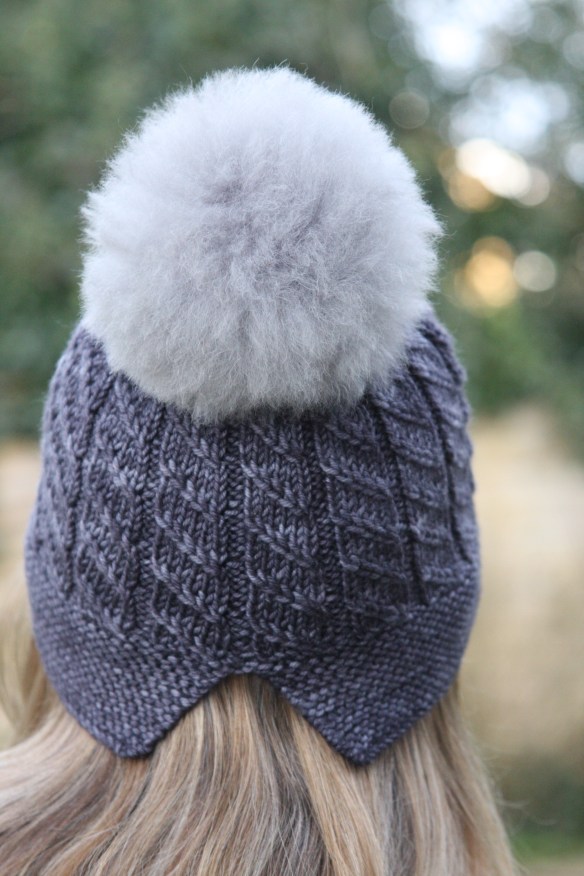
Regular readers of this blog will know that my first attempt at this hat was a disaster, not because of any problem with the yarn or pattern but because I wasn’t paying attention.  (A little bit of stupidity was likely in play as well.)  The pattern, designed by Wooly Wormhead, and called Skelter, is completely lovely.  The stitch pattern is beautiful, and I love the way the decreases work into the crown:

IMG_1899

Of course, you can’t see this beauty if you have a pom pom attached, but more on that in a moment.  The problem with the first hat was caused by not doing a gauge swatch and not using a tape measure.  With the second attempt, I kept the needle size the same (US6) but increased to the largest size (my head is big, but my gauge is also slightly under, so the result fits my 21″ head perfectly without being snug).  I knit 2″ of brim and then 5 pattern repeats before starting the decreases.  The completed hat used 66 grams of yarn (only 51 in the “teeny tiny hat” – my abortive first attempt).  If you use this yarn, please note that it can stretch quite a bit when it is washed; I was very careful to push it all back into the size I wanted before drying flat.  It is a gorgeous yarn, however, and lovely to knit with.  I knit this fabulous sweater with it a few years ago.

The brim of this pattern has a notch at the back; it turns out that it is perfectly placed for ponytail wearers:

IMG_1903

Here is a funny but true tale.  Shortly after I ordered the supplies for this hat, I was passing though the Duty Free shop at Heathrow International Airport in London.  I saw the below hat, and just had to take a photo for you.  I draw your attention not so much to the hat, but rather to the price tag:

20160213_123158

It’s a little hard to see, but the gist is: “Suggested price: £357, Our price £297.50, You save £59.50”  This cracked me up!  The GBP has taken a pounding in the last few weeks, but even at today’s less than stellar rates, this translates into dollars as “Suggested price $497, Our price $414, You save $83”.  I can hardly type this without giggling!  For my hat, I bought one skein of an extremely luxe hand-dyed yarn for £24 (of which I used .65 of a skein) and one pom pom for £8.  I happen to think mine is prettier too, but that is a matter of taste.

So now, the real question:  Pom pom?

IMG_1908

Or no pom pom?

IMG_1895

Pom pom?

IMG_1909

Or no pom pom?

IMG_1894

I can’t believe I’m saying this, but the pom pom is actually starting to grow on me!

IMG_1921

How to end your knitting year with a bang!

IMG_1739-002

Early last Fall, I decided to knit a sweater for my daughter, Emma, for Christmas.  Unlike my usual habit of making such decisions in December, I started planning in September, and thus was pretty much assured of success.  I hit a small problem almost immediately – I could not choose a pattern!  I have around a thousand sweater patterns in my favorites file, so it isn’t a problem of access or inspiration.  I think part of it is that Emma has a very clear sense of what she likes and what she doesn’t; she is supremely stylish  and particular.  Since I wanted the present to be a surprise, I couldn’t consult with her.

Just as I was about to despair on finding the absolutely right, perfect sweater for Emma, I remembered the skirt pattern Intolerable Cruelty (yes, that is its name; I would advise you perhaps not to google for it).  This skirt was designed by Ashley Moncrief and published in Knitty in 2006 (pre-Ravelry!!!).  I remember looking at it at the time with Emma and both of us commenting that it was a great design.

IMG_1767

I even had some yarn in my stash that I thought would work: Juniper Moon Farm Findley DK, a 50/50 blend of merino wool and mulberry silk in Grey.  The silk blend would give the skirt a nice drape, I thought, and grey is definitely a good colour for Emma.  I also didn’t want to use a hand-dyed yarn because I didn’t want to deal with dye variations and changing skeins.  I had bought this yarn last year from Loop in an effort to expand my yarn repertoire to some less expensive yarns.  Furthermore, because it was already in my stash, Kelly’s Rule of Creative Accounting meant it was free.

IMG_1742

Intolerable Cruely has been knit many times over the year (there are over 250 projects on Ravelry).  My general impression, looking over these projects, is that the skirt looks great on many different body types:  it is good for tall, willowy figures like Emma as well as for very curvy figures.  What I didn’t like about many of the projects, however, was the ruffle.  In the pattern the ruffle is knit in the same yarn as the skirt; with many yarns this ends up looking just a bit clunky.    I found myself thinking that a lighter-weight yarn would work much better.   I dragged Doug to the yarn shop, along with the half-knitted skirt, to pick out a lighter yarn for the ruffle.  We settled on this beautiful blue-grey shade of Kidsilk Haze.

IMG_1763

I do think that the Kidsilk Haze gives a little life, not to mention lift, to the ruffle:

IMG_1778

I was to hit two more problems while knitting this.  The first is that Emma was 4706 miles away (as the crow flies).  I really struggled with making this using guesswork for the size.  I did have some basic measurements, but the whole process would have been a piece of cake if Emma were able to try it on every few inches.  My confidence levels would have been considerably higher as well.  I decided that Emma would need a size Small, but since my gauge was slightly bigger (23.5 stitches instead of 25), I knit the Extra Small to get a Small.  Emma is very tall, however, so I used the directions for the Medium size with respect to length.  I could have made it even longer, particularly the top portion, where the corseting is.

IMG_1734-002

The second, much more serious problem, was that I had only knit about 10 inches of the skirt when I developed a flare-up of DeQuervaine’s tenosynovitis in my left wrist, and had to stop knitting altogether for over eight weeks.  Even when I could start up again, I had to carefully curtail my knitting so as not to exacerbate my recovery.  I finished the skirt, except for blocking, on the 23rd of December!  (The girls arrived home on the 24th; how is that for timing?)

IMG_1757

The skirt is knit top-down in the round.  I usually find that elastic waists on hand-knit skirts are very clunky but I had no such problems here.  The waistband is astonishingly flat and smooth and works perfectly.

IMG_1758

Also, the shapings at the side of the skirt look really elegant in this yarn:

IMG_1756

I am really happy with how this turned out. The yarn changed quite a bit on washing, becoming much softer and slinkier; the drape is excellent.  The real stand-out feature of the skirt is the corseting up the back; the ribbon gives a great flirty kick to the design.  Note that the ribbon can be changed to match your outfit.

IMG_1733-001

This is a lovely, well-written pattern that has stood the test of time and which looks great on many different body types.  It looks good on models of all ages and with a wide range of personal styles.  Not only that, it is free!

IMG_1771

Emma had arrived for Christmas with a carry-on bag and had none of her usual party clothes or shoes to model with this.  Nevertheless, she managed to whip up something that looks great and Doug, as usual, did a good job with the camera.  I am relieved that it turned out so well.  This was really a case of of finishing off my knitting year with a bang!

IMG_1781


Crazy for Candlewick

IMG_1695

I can’t stop knitting things for Leah in the rich golden colour called Candlewick from Madelinetosh.

In the summer of 2014 I knit Leah a cardigan (Peloponnese by Sandi Rosner for Twist Collective) that used Candlewick as an accent colour against Composition Book Grey.  I blogged about it here, where you will find all of the details and many great photos.  The cardigan was a huge hit and I am told that Leah practically lives in it:

10-IMG_9778

She was very enamoured of the lovely rich tones of the Candlewick, so I ordered more yarn and made the cowl as a surprise last Christmas, using the Cabernet Infinity Scarf – DK pattern by Monika Sirna.


IMG_0548

I had a skein of the yarn leftover, so this Christmas I whipped out a pair of fingerless mitts to match.

IMG_1675

Monika Sirna recently released a mitt pattern to match the cowl, but I decided not to use it.  First, it was designed for worsted weight while my yarn was DK, but I also found the pattern to be a bit busy.  I decided that I wanted a pair of simple stockinette mitts with a single pattern of the cable running up the back ; I think they turned out elegant.  I didn’t take any notes – I used double pointed needles in a US size 5, put in a single pattern repeat with one purl stitch on either side, and added a thumb gusset.  The only slightly tricky part was incorporating the pattern repeat into the ribbing on the bottom and top of the mitts (which involved decreasing one stitch as the count was off by one, if I recall).

IMG_1683

Leah loves them and I think they will get a lot of wear.  This colour really suits her.

We are having an astonishlingly warm Christmas here in southern England.  The photo above of Leah in her Peloponesse cardigan was taken in August year before last, the other photos are taken today in late December.  I think the temperatures are probably the same today as they were on that summer day.  Everything is green, and you can see the rosehips on the rose bush and the flowers blooming behind Leah.  I have no doubt that the cold will arrive eventually and then hopefully the Candlewick mitts and cowl will be both cheerful and warm.

IMG_1692